
Style
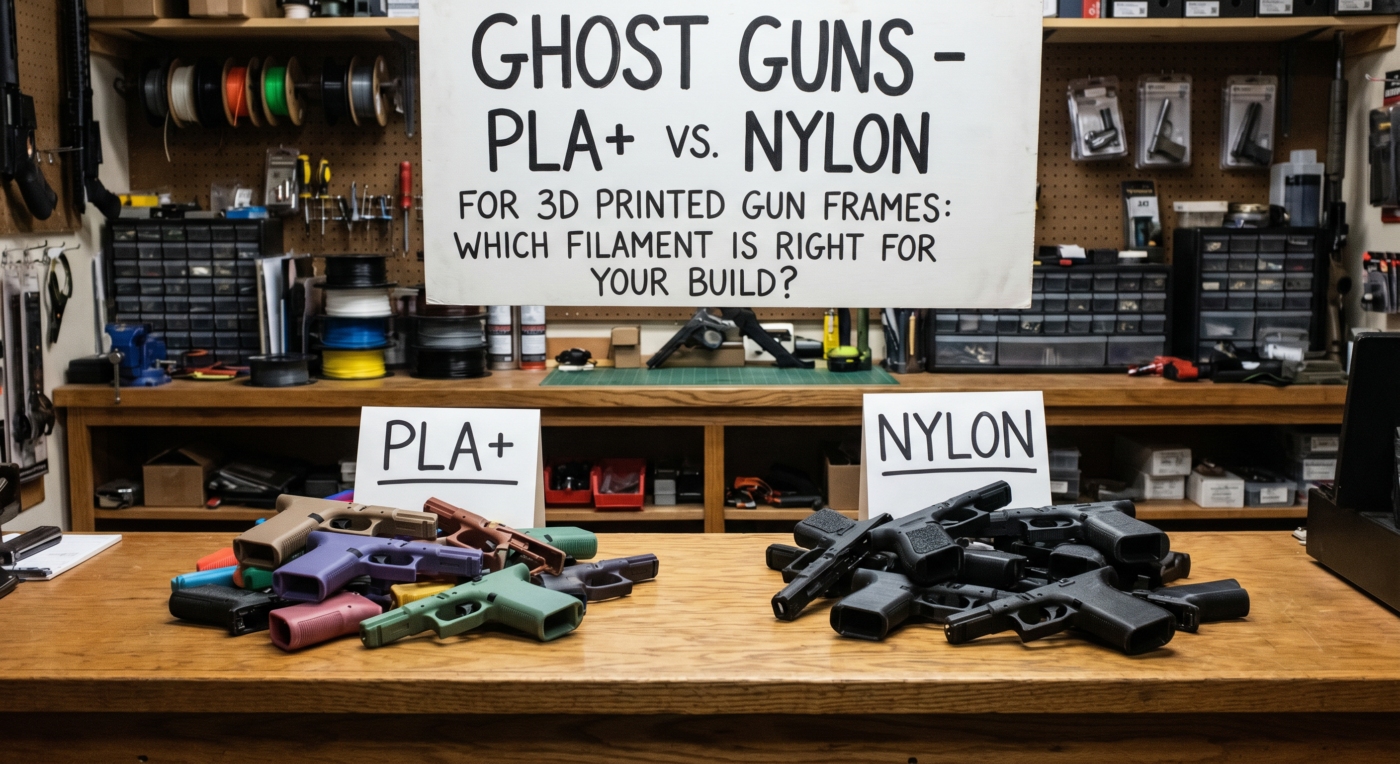
PLA+ vs. Nylon for 3D Printed Gun Frames: Which Filament is Right for Your Build?
Apr
PLA+ vs. Nylon for 3D Printed Gun Frames: Which Filament is Right for Your Build?
When 3D printing a firearm frame or receiver, your choice of filament is the single most important factor determining the final product’s strength, durability, and safety. While standard PLA is fine for hobbyist prints, it is completely unsuitable for this application.
The two leading materials for the job are PLA+ (also called PLA Pro) and Carbon Fiber Nylon (PA-CF). This guide will break down the differences to help you select the right material for your project’s goals and budget.
PLA+: The Accessible Standard
PLA+ is a specialized formulation of PLA (Polylactic Acid) that has been modified with additives to dramatically improve its mechanical properties, making it the go-to entry point for 3D printed frames.
- Pros of PLA+:
- Ease of Printing: It prints at lower temperatures than Nylon and is less prone to warping, making it compatible with most consumer-grade 3D printers.
- Excellent Rigidity: PLA+ is very stiff, which helps maintain the precise tolerances needed for a firearm frame.
- Cost-Effective: It is significantly cheaper than Nylon filaments, lowering the barrier to entry.
- Cons of PLA+:
- Low Heat Resistance: Its primary weakness is a low glass transition temperature (around 60°C / 140°F). A frame left in a hot car on a summer day can deform and become unsafe.
- Lower Impact Resistance: While much stronger than standard PLA, it is more brittle than Nylon and can be more susceptible to cracking under sharp impacts.
Conclusion: PLA+ is an excellent, affordable choice for range use and for builders learning the process.
Carbon Fiber Nylon (PA-CF): The Professional-Grade Option
Nylon (Polyamide) is an engineering-grade thermoplastic known for its toughness and durability. When reinforced with chopped carbon fibers, it becomes one of the strongest and most robust materials available for desktop 3D printing.
- Pros of Nylon-CF:
- Exceptional Strength & Durability: It has superior tensile strength and impact resistance, creating a part that can withstand significant abuse.
- High Heat Resistance: Nylon has a much higher melting point and heat deflection temperature than PLA+, ensuring the frame remains stable even in extreme environments.
- Wear Resistance: It has a low coefficient of friction, making it ideal for parts that experience rubbing or mechanical wear.
- Cons of Nylon-CF:
- Difficult to Print: Nylon is highly hygroscopic (it absorbs moisture from the air) and requires a filament dryer for best results. It also requires an all-metal hotend, higher printing temperatures, and often an enclosure to prevent warping.
- Abrasive: The carbon fibers will quickly wear out a standard brass nozzle. A hardened steel nozzle is mandatory.
- Higher Cost: Nylon-CF is a premium material and costs significantly more than PLA+.
Conclusion: Carbon Fiber Nylon is the superior material for a duty-grade, long-lasting firearm that can handle hard use and extreme temperatures.
The Verdict: Which Should You Choose?
- Choose PLA+ if: You are new to 3D printing, want an affordable and easy-to-print option, and will primarily use the firearm in moderate temperature environments.
- Choose Nylon-CF if: You demand maximum durability and heat resistance, have a well-calibrated printer capable of handling engineering filaments, and are building a firearm for serious, long-term use.
Ready to print? We provide access to high-quality, tested files and the materials you need to get started.
